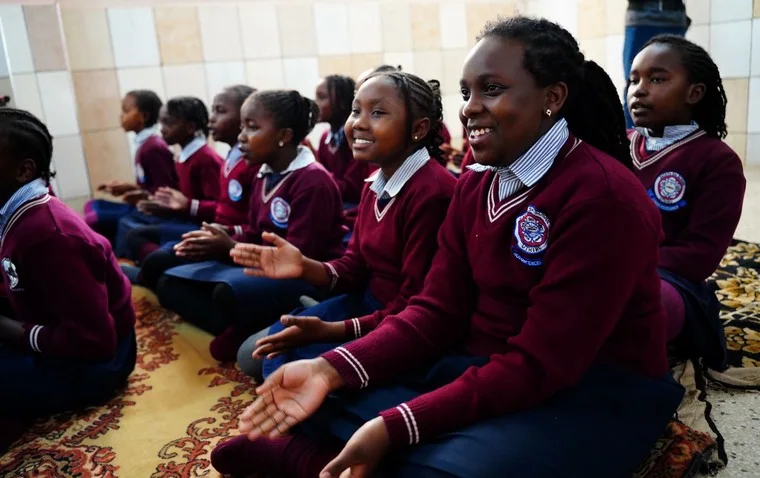
Inside the school
From a children’s home to a beacon of light
What began in 1997 as a children’s home for 40 to 45 children is now a day school for 160 learners. Every child is fed twice a day, no child is caned, and children carry what they learn home to their villages.
Help this school growA home that grew into a school
In 1995, Margarita Hawley began providing children in Nairobi with food and a safe place to stay. In 1997 she and a few other devotees, Nimesh Shah among them, opened a children’s home for 40 to 45 children who needed care and shelter. It was a makeshift building of corrugated sheets, in very poor condition, but it gave the children shelter, food, loving care and daily lessons in human values.
In 1999 one of the trustees travelled to Prasanthi Nilayam, Sathya Sai Baba’s ashram in India, and around then the home’s headmaster took part in an education conference there. Seeing how Sathya Sai schools were growing, those who ran the home bought land and put up a building. In 2000 the home closed and the day school opened. The Sathya Sai School (Uthiru) Trust was registered in 2007. Uthiru’s October 2025 profile describes a day school from preschool to Grade 6, welcoming children across economic, ethnic and religious backgrounds.
A day of learning, meals and values
In August 2026 the school had 160 learners, from PP1 at about age four to Grade 6, with nine teachers and five support staff. Most come from very poor homes. Every child gets two free meals a day, and for many the school meal is the first of the day, often because there was no evening meal at home.
Lessons follow Kenya’s competency-based curriculum, with music, drama and games alongside academics. Teachers do not use the cane; they correct children through guidance, and parents are brought in through regular clinic days. Sathya Sai Education in Human Values connects learning with character and care for others. Teachers undertake training and use school breaks for further learning; the Sathya Sai Institute in South Africa trains them in values-based education, and the head teacher runs regular study circles with his staff. The school’s June 2024 history describes devotional singing, community service and physical fitness alongside lessons. In its account of the 2024 Kenya conference, SSSIO praised the Uthiru teachers’ dedication and the pupils’ songs, respectful welcome and enthusiasm.
The people behind the school
The people who stayed
A head teacher who came looking for a job, and a businessman asked to take charge of a school. Sam Mwangi and Nimesh Shah describe why they serve.
Sam Mwangi
Head teacher · at the school since 2003
“Literally the kids motivated me so much. And of course, love for God.”
13 August 2026
Sam came to the school in 2003 simply looking for work. Many of the children then came from the streets. He would pick out a child who was struggling and give himself three years to see whether he could help that child change. Before long, he says, many children wanted him to be part of their lives.
In those early years he taught in a tent: “you come in the morning and you find the tent. There was some storm yesterday and the tent is down. So you have to fix the tent first.” He rose from classroom teacher to senior teacher, examinations, deputy and head teacher. Private schools have asked him to run their schools, but for him, he says, God’s way of life “is not about the money.” The hardest part of the job, he says, is weighing what trustees, parents, government and children each need; whenever he surrenders to God, he finds the strength to continue.
When he joined, he had never heard of Sathya Sai Baba: “I really, really had no idea.” In 2008 he flew to India for a conference. He saw Sai Baba, though protocol meant he could not meet him personally, but “the experience was very good.” He came home having learned that “It’s good to be humble. It’s good to be dedicated.” He also came back convinced that a school should open its doors to children as young as four, because, like a tree planted where there is water, a child moulded young grows and bears fruit.
Who is Sai Baba to Sam?
“You have to literally introduce the school and Sai Baba must be the center of that. He’s a spiritual leader.”
On what he tells every family seeking admission · 13 August 2026Nimesh Shah
Chair of the trust · has run the school since 2005
“I took it without any looking back at anything.”
On being asked to take charge of the school in 2005 · 13 August 2026
Nimesh was one of the devotees who started the children’s home in 1997. By 2005 the school needed new leadership. Victor Kanu of the African Institute of Sathya Sai Education asked Nimesh to take charge, with Kanu as chair to guide him. “I had no background on education of running a school or anything because I’m a businessman,” he says. He accepted out of “my love for our Lord.” He put the school on a steady footing, and the trust has raised teachers’ pay every two years from its own funds.
He enrols children “who are in dire need”: orphans, children of single parents and children left with the county. The trust plans six months ahead and meets over 70% of the children’s needs. His goal is to make the school “a beacon of light,” and he counts its long-serving teachers, who have stood with the school through its ups and downs, as its greatest wealth. He hopes service to the neighbours, from food for the needy to weekend feeding, will become a daily part of school life.
Who is Sai Baba to Nimesh?
“The faith and trust in Bhagavan has been the pivotal thing.”
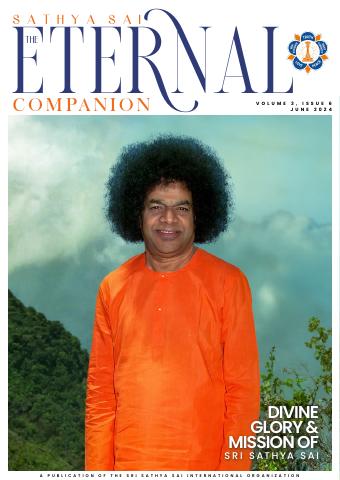
Bhagavan (Lord) is how devotees speak of Sathya Sai Baba · 13 August 2026Sri Sathya Sai Baba was an Indian spiritual teacher whose message of love and service inspired people around the world. His teachings centre on five human values (truth, right conduct, peace, love and non-violence), and every Sathya Sai school is built on them. Read our story
The trust a teacher can build
Daniel Otieno, an early principal, trained at the African Institute of Sathya Sai Education in Zambia and received his diploma from Sathya Sai Baba in November 2001. The school’s published history recounts his belief that Sai Baba’s teachings and loving care helped children rebuild trust. It remembers the joy children found in devotional singing.
Children who become lights
The school spends little on advertising. Its head teacher, Sam Mwangi, says families come because of what they see in their neighbours’ children: when a child changes, the neighbours want to know why. In national examinations, he says, Uthiru pupils perform very well within the area.
Under the old 8-4-4 system, when the school taught up to Grade 8, its candidates went on to national and extra-county secondary schools and then to university. Some now work in national banks. One former pupil is studying medicine at the University of Nairobi. A boy who had no parents, and was cared for by a distant aunt, now works as an auditor. The junior schools that receive Uthiru’s Grade 6 leavers tell the head teacher the same thing about them.
Achievement that encourages every child
Five Uthiru pupils were recognised for first place in the 2024 National Yogasana Championship, which the school hosted on 28 March. During the 2025 reporting period, every child at the kindergarten awards day received a certificate, and teachers received tokens of appreciation. Earlier academic recognition is recorded in the SSSIO Education Report 2019–2020: on 28 May 2019, the SSSIO of Kenya received a Ministry of Education letter appreciating Uthiru’s outstanding academic performance. The report also records the school’s accreditation by the SSSIO Education Committee in November 2019.
Children sharing their voices
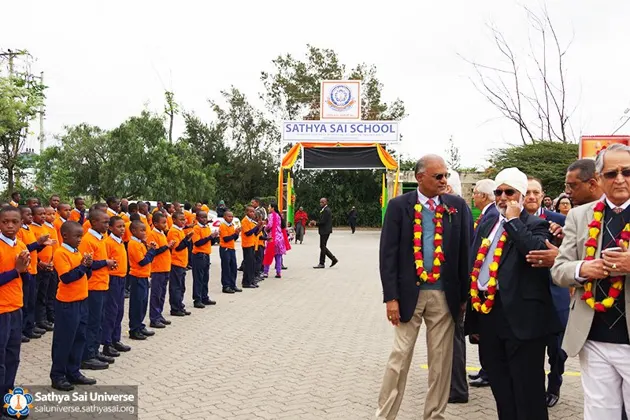
On 13 July 2018, Uthiru pupils welcomed visiting SSSIO leaders with a cultural programme marking the Golden Jubilee of Sathya Sai Baba’s visit to East Africa. Their primary children’s drama, “Most Important Quality in a Leader,” was published by SSSIO in August 2024. The films on this page include that performance, alongside the school story, human-values film and prayer session.
In late July 2026, a visitor invited the children to ask him anything. They wanted to know who Sai Baba is, and what Sathya and Sai mean. Nimesh Shah recalls how much it meant to them.
Care carried into the community
When classrooms closed during the COVID-19 pandemic, teachers took food, blankets and clothing to nearby villages. The October 2025 school profile records 5,400 food hampers delivered to homes during that period. Community service has also included cleaning, hygiene and support for elderly families. In the 2025 reporting year, Uthiru and the Sathya Sai Centre organised another food distribution for community members.
A friend of the school who exports vegetables sends about 15 kinds of fresh produce, 500 to 600 kg at a time, export-quality mangoes included. The school does not store what it cannot use; it shares it with people in need nearby. In August 2026 it was giving out food every week to women in need near the school.
In November 2026, Uthiru teachers Eric, Mercy and Kabera helped share food parcels with families in nearby villages to mark Sri Sathya Sai Baba’s birthday. They visited some families at home. Pupils and a mother also wanted to lend a hand. One person offered a prayer in their own language, thanking God and asking for blessings for the school’s founder and its well-wishers.
The school has also begun a partnership with a nearby school, whose principal visited and was struck by how Uthiru children tell right from wrong. Sam Mwangi has held sessions with him on teaching human values, and the two schools planned a shared exam and joint games, so children learn that for every winner there is a loser, and that losing today is a chance to try better next time. His hope is that this way of teaching spreads to several schools in the area.
Families learning together
At a May 2025 parents’ meeting, a nutritionist shared practical ways to prepare nourishing meals and explained why breakfast matters. Other meetings during the 2025 reporting period helped parents understand the school’s ethos. The work brought families into the conversation about children’s learning and everyday care.
A better place to learn
Better kitchen and toilet facilities were the latest campus improvements reported in June 2024, part of the school’s continuing effort to keep its environment conducive to learning. By August 2026 the whole toilet block had been refurbished, with good facilities for girls and boys. The trust upgrades something every year, always putting children and teachers first and buildings after.
What would help next
In its October 2025 profile the school listed 170 pupils, 70 per cent of whom received education, meals and uniforms free of charge, while the remaining families paid a small fee. Enrolment was 160 in August 2026, down from over 180 before 2022, when Kenya’s new curriculum moved Grades 7 and 8 out of primary schools. The trustees and head teacher have chosen to wait until the new junior secondary level settles before taking it on.
In August 2026 the trust and the head teacher named their priorities. First, the welfare of the teachers, many of whom have stood by the school for years. Next, a kitchen that no longer relies on wood fires, which is smoky and wasteful; freezers, so that donated produce arriving late in the week does not spoil over the weekend; solar power for the kitchen and computer room, so that power cuts no longer interrupt lessons; and a projector to help young learners. To help, use the support enquiry on this page: the Schools Committee can explain Uthiru’s current priorities and guide an offer of help.